Panama exited the world's biggest reading exam. In a tiny jungle school, we spent two years asking a smaller question: what does it actually take to get children to read?
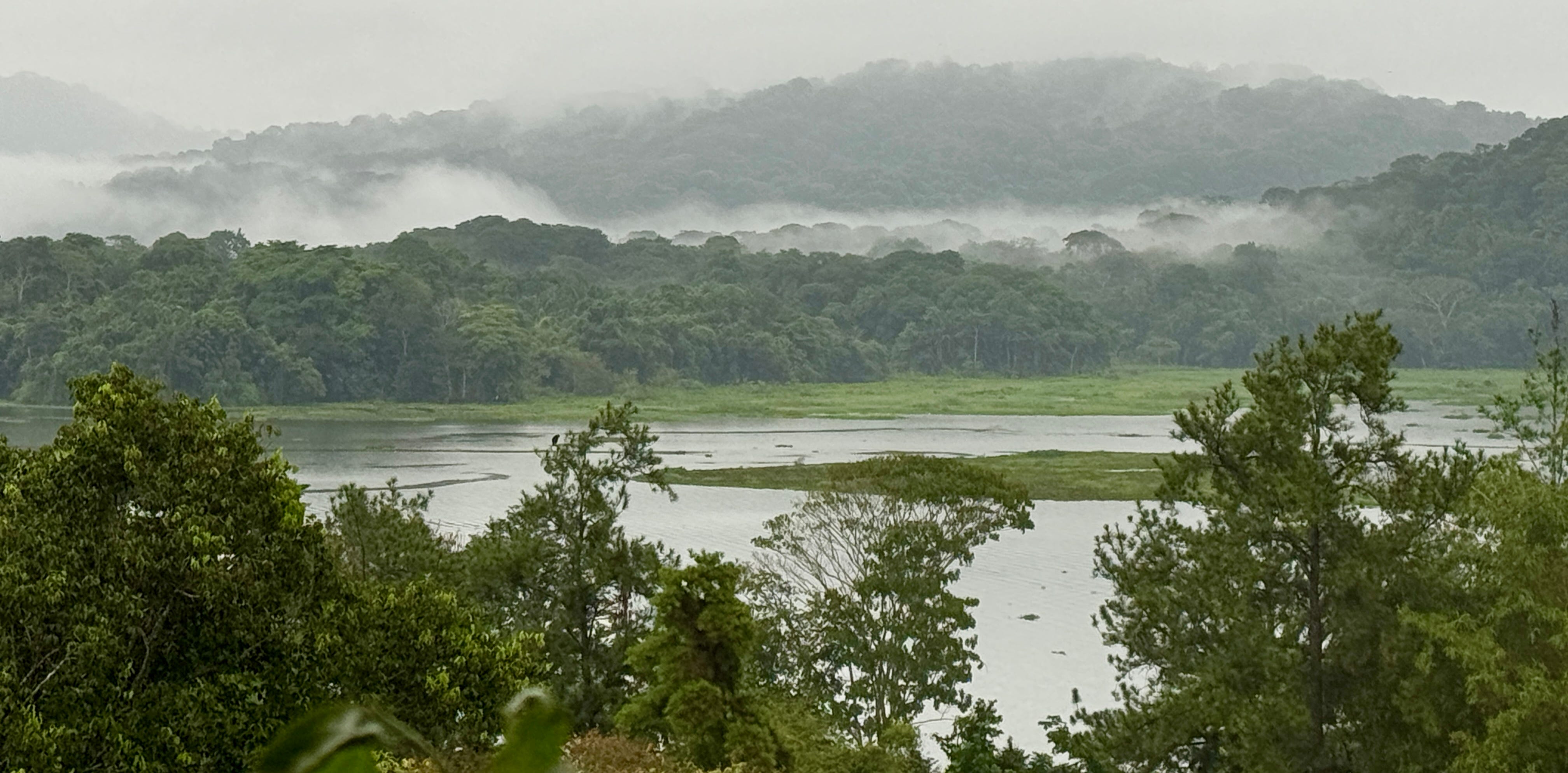
I am at a rooftop café above the Panamanian rainforest. It is raining. Low clouds snake through the trees. For a moment I stare in childlike awe. But, behind me, at the next table, a child is watching something on a tablet. It sounds like cars crashing over and over. It is really loud. One table over a mother sits with two children, each nose buried in a separate device, all three look comatose. Further on, a boy is screaming at full volume into his father’s phone, which is being held up to his face, force-fed.

I open my laptop to read the OECD’s PISA results that hit my newsfeeds earlier this week, and find the data already being acted out behind me.
The numbers are the worst on record. Across the OECD the average reading score has fallen to 461, the lowest since the survey began. One in five fifteen-year-olds is now a low performer in science, mathematics and reading. After three hours on screen, combining in class and at home, performance falls.
Panama is not in this round. In July 2024 the Ministry of Education notified the OECD that the country would withdraw. The minister, Lucy Molinar, made a cost argument. The test cost over 200,000 balboas, and with that money, she could train teachers and equip schools. She also made a second argument, quieter and more interesting, that the exam would only confirm what everyone already knows. Panama had come 74th of 81 in 2022, and 71st of 77 in 2018. The country plans to return in 2029, after a curriculum redesign.
Freire called it the banking model of education. Run a school like a bank and Molinar’s question is the only sensible one: where is the return?
I sympathize. I spent the last two years running a reading intervention in which tests and grades were nonexistant. Students got specific feedback constantly, every day, from adults sitting beside them.
Here I will explain what we built instead, starting with this basic concept.
Independent reading is absolutely not about leaving the child alone to read. It is the most supported thing we do all day.
Everything in the room exists to make it happen.
Independent reading is absolutely not about leaving the child alone to read. It is the most supported thing we do all day.
The school
Two years ago I took on the coordination of a micro middle school in a very particular place. A jungle school, people called it, a mix of Panamanians and expats, set among beach, patches of rainforest, mangrove, ranch and farmland, real-estate development, and waterfalls.
When we surveyed the families, most parents admitted their child had never read a complete chapter book. Students were generally a grade level or more below. Over 90% were neurodiverse. We used i-Ready as a starting-point assessment and DIBELS for running records, and I borrowed a set of Words Their Way books from a primary teacher.
We began with fourteen students. The place is transient, the number fell to seven at one point and came back up to ten. Most of what follows is drawn from the core cohort who started and finished the full two years.
One thing set this group apart from interventions I have worked on in public schools and larger international schools. Most of these students had grown up here, and some had never known any other kind of school. They all had devices, and the pull of them grew noticeably by seventh grade. But they did not live inside the 360-degree screenscape that surrounds an urban child. The opportunity cost of time was filled less with screens, and more with surfing, jiu-jitsu, or hanging out with friends.
The intervention had five pillars: silent reading, read-aloud, guided reading, phonics and grammar, and writer’s workshop. Ninety minutes daily as a minimum, stretching to 120 two or three times a week. Homework ran an hour, thirty minutes of which was deliberately tied to the next day’s literacy lessons. All required reading happened on campus, though the enrollment contract asked for an hour a day on weekends and holidays.
Here I will only outline the first block, silent reading, about thirty minutes of the day.
Support 1: Time Nothing Can Take
Silent reading happens first thing in the morning, before the morning meeting.
That is by design. The first three events of the day were silent reading, morning meeting and read-aloud. Together they announced our priorities of independent reading of whole books, individual and collective well-being, and the modeling of fluent reading and thinking about reading by an adult. If schools are model democracies with acceptable levels of chaos and anarchy, then doing these first ensures they get done. It also gives the literacy block brackets of student autonomy, beginning with silent reading, ending with writer’s workshop.
For the first few minutes, teachers and staff do nothing but greet students and get them started.
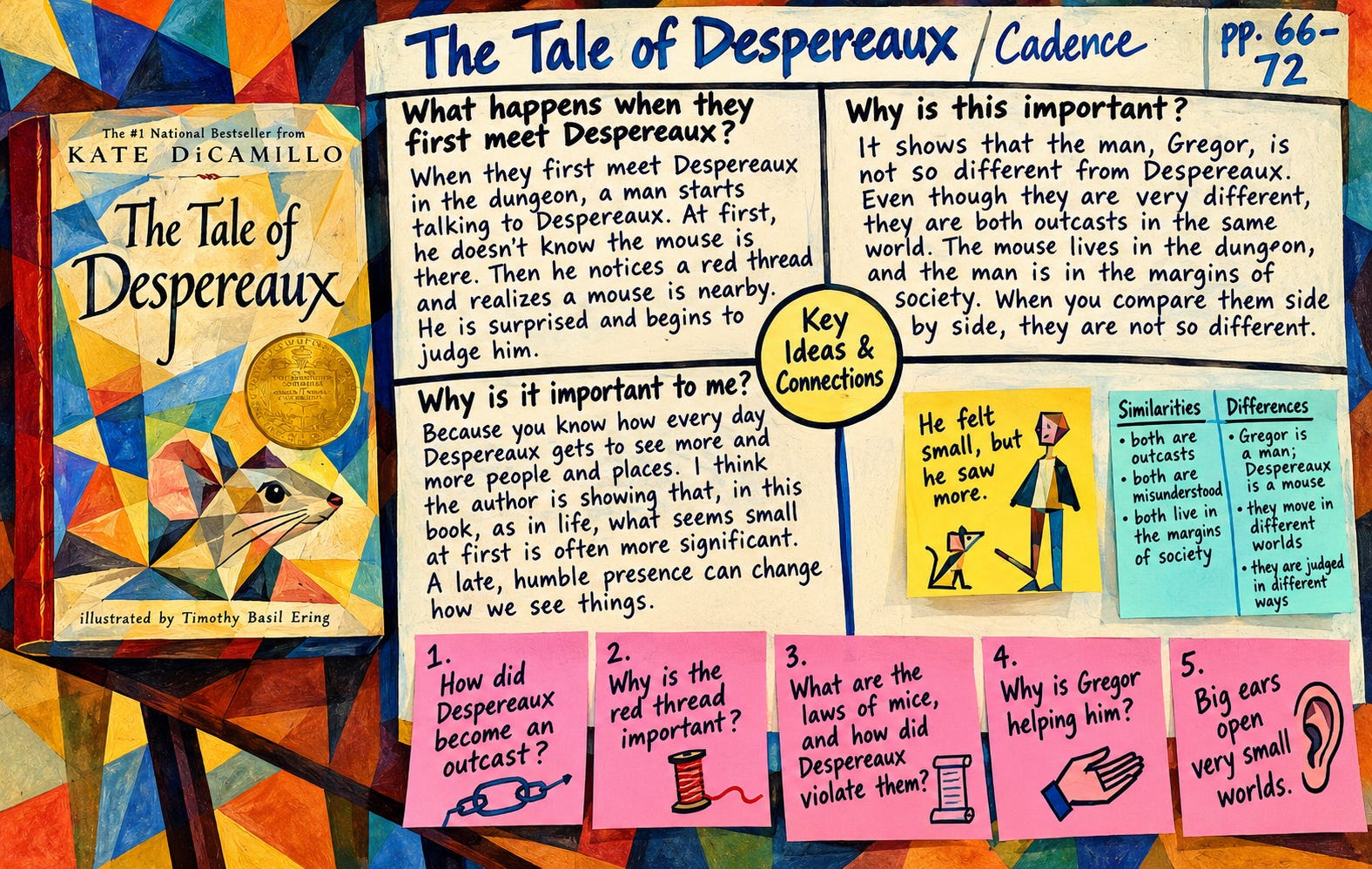
Each student sets up with the toolkit of two Post-its, a Sharpie, and a book.
Then, for twenty-five minutes, they read.
There are only two prompts. On the first Post-it, track unknown words, the word and the page number. And second, notice the part of the text you find most interesting, which for most plot-driven readers means where the emotion or the action spikes. They are told to read straight through, bookmarking anything they might want to return to.
This multiple engagement with different lenses on text matters. The goal in these twenty-five minutes is stamina and fluency, not to get lost in thought. It is a photographic approach where in the decisive moment the photographer has honed a sharp sense of noticing when things are happening, but it may only be in the reframing, traditionally in a darkroom with special lighting, that an image is rocked and coaxed into being, often provoking a deep sense of empathy from the now viewer. In other words, thinking comes later with a different toolkit and mindset. A student who stops to reflect on page four has usually stopped reading by page six. Fluency first. We were explicit with them about this, and students liked knowing which job they were doing.
Support 2: Walls that Talk
At the end of the twenty-five minutes, everything changes.
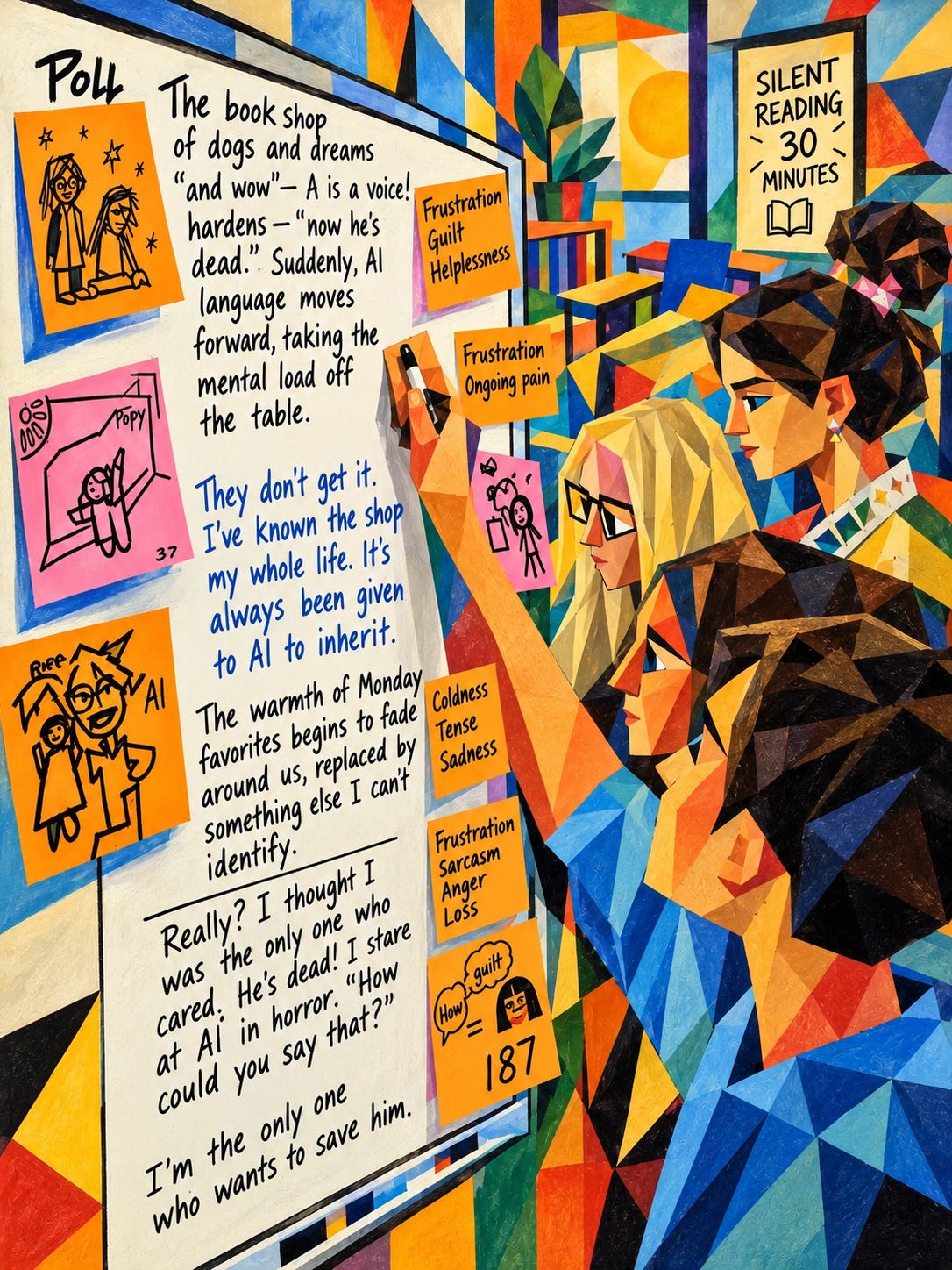
Students go back into the text, put a finger on one part, and sketch it for sixty seconds. Then they label and caption the Post-it and peg it to a reflection wipe board in their own designated space. There they write — some just recounting what happened, others reaching for a thinking move they will use later in the week. They are encouraged to talk about what they wrote. One student shares out to the room.
Let me slow down here, because this small sequence is at the heart of the intervention.
Reading is private. It happens somewhere no adult can go. The paradoxical problem of teaching is that the moment you ask a child to make that private thing visible, you risk turning the reading into a performance of having read, which is what a comprehension quiz is, and why children learn to hate books.
The sixty-second sketch is a way through. It is too fast to be good. That is the point. Nobody can make a sixty-second drawing on a Post-it with a fat Sharpie into an achievement, so nobody tries to focus there. What comes out is less of a summary and more evidence of where the reader’s attention actually went.
The materials do the same work. We used only Post-its, a wall-mounted wipe board, individual wipe boards, and Google Docs for editing and revision later in the week. During guided reading and writer’s workshop, students wrote in their notebooks exclusively. I wanted the medium to be different here, to let the tools mark the difference of the space. Everything in the silent reading block wipes clean. Everything is temporary, more risk-free. Nothing accumulates into a record that can be held against you. Only later, through reflection and conversation, did some of that thinking enter the longer record.
The paradoxical problem of teaching is that the moment you ask a child to make that private thing visible, you risk turning the reading into a performance of having read…
The individual boards line up on nails along the wall. A projector fills another wall with whatever collaborative document is live, so the class’s work is always up there, at scale, visible to everyone. Sketches and half-written reflections stay up while they are in progress, and finished reflections stay up for a week. That is a deliberate signal, validating student thinking by making it visible, and the cheapest intervention in the building, interactive walls. The room should look like people read in it. If printing the weekly transcripts had been feasible, I would have hung those too.
Support 3: Adults Present but Not Teaching
Release is not the absence of the adults. Release is what the adults are for.
Throughout the block the teachers are busy, conferring one-on-one, taking a running record, monitoring an intervention, reading alongside a student, or walking someone through a written reflection from a previous day.
Notice, these supports are social-emotional and organizational. They are not whole group direct instruction.
The usual model of gradual release starts with read-aloud, then guided reading, then independent reading, with the adults less present as you go. This version inverts what adult presence means. During silent reading we had the most adults in the room and the least teaching. Nobody was delivering content. Everybody was making it possible for a twelve-year-old to sit still with a book for twenty-five minutes with the intent of constructing something meaningful, not take an AR test or fill out a log and get a parent’s signature.
Release is not the absence of the adults. Release is what the adults are for.
Support 4: A Log They Own
While students wait for the morning meeting to start, they update their reading logs.
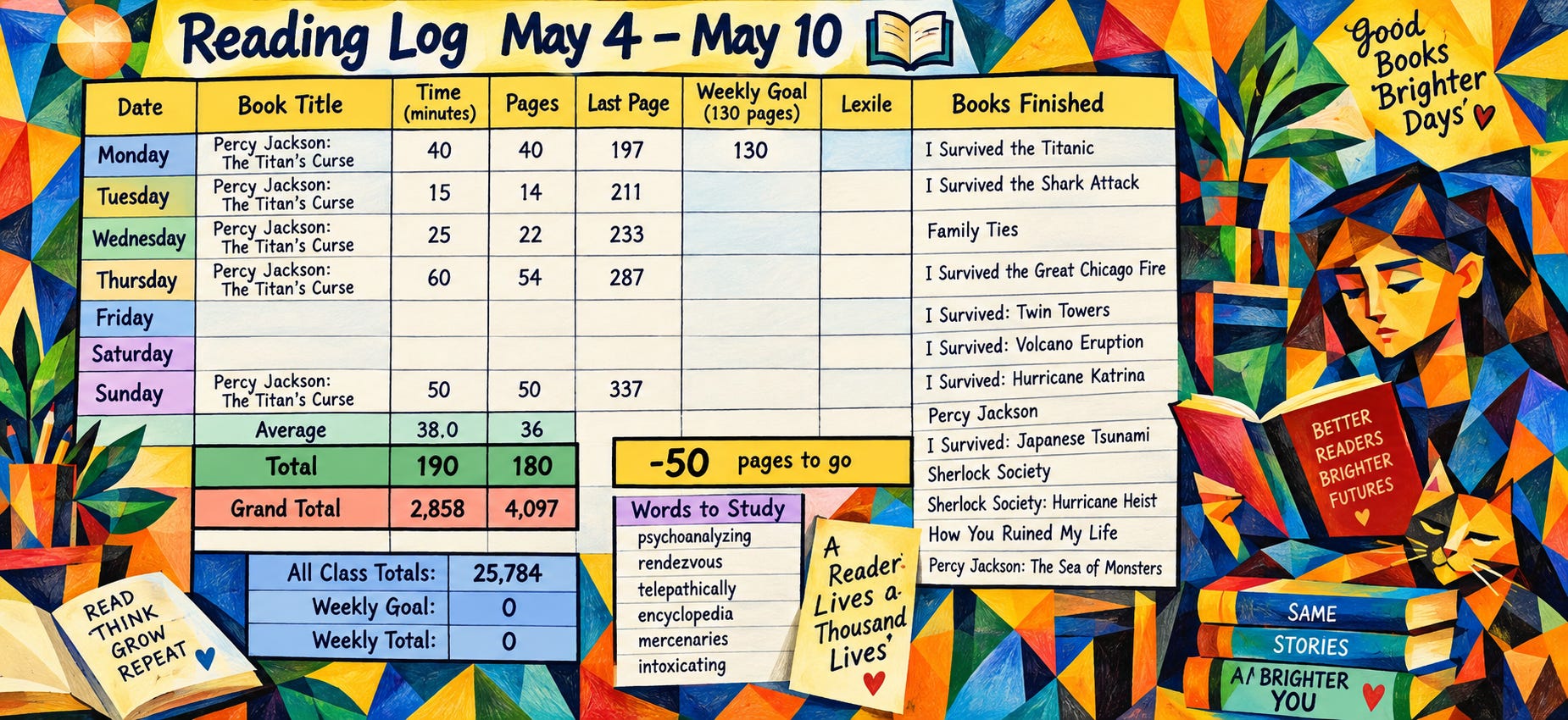
This format was not designed. It grew ad hoc in the first year as a way to set weekly goals, and within a month it had become a Google Sheet where each student kept a weekly tab: minutes read, pages, new vocabulary with page numbers, books read, books to read, Lexile levels. Individual totals accumulate. Each sheet feeds a master sheet, which generates group totals and pushes them back down. Students can see the class total. Nobody can see anyone else’s log.
That part was the only teacher non-negotiable design decision, collective progress public, individual progress private.
There is a great deal more to do here, and my strong advice to anyone copying it is to home-grow the thing as a teacher-student co-creation. We changed the logs constantly, adding columns as students asked for them, until they had turned into personal reading dashboards. This cohort took ownership and kept them current through the trimester.
The moment a log becomes compliance it starts measuring compliance.
It has to be voluntary. The moment a log becomes compliance it starts measuring compliance. For us it stayed what it was meant to be, goal setting, an awareness of one’s own book choices, and a sense of pride in the number of books read over time.
Support 5: A Menu on the Wall
On the fifth day the routine breaks open into ninety minutes of long reflection and Socratic discussion.
Students reread their own reflections from the week and choose one to go deeper on. They apply a thinking move, or invent one. They write at length. They plan interviews, record them, revise and edit them, then package and publish them to the community. All of it inside the block.
This is why the week’s sketches are deliberately short. Record just enough thinking to invite a revisit for a deeper dive, an invitation to oneself, not a report.
The thinking moves themselves had been modeled all year in read-aloud and guided reading, and they live permanently on the wall as a menu. Some come from Making Thinking Visible such as Circle of Viewpoints and Color Symbol Image. Some were collected at different Science, Reading, or Design Thinking workshops such as Claim-Evidence-Reasoning, PEEL, empathy mapping through say-do-think-feel. And some we adapted from Barthes. Five codes, which we taught as channels a reader can tune into. Enigma. Action, the story mountain. The semantic, characters and symbols. The symbolic, binary oppositions. Cultural reference.
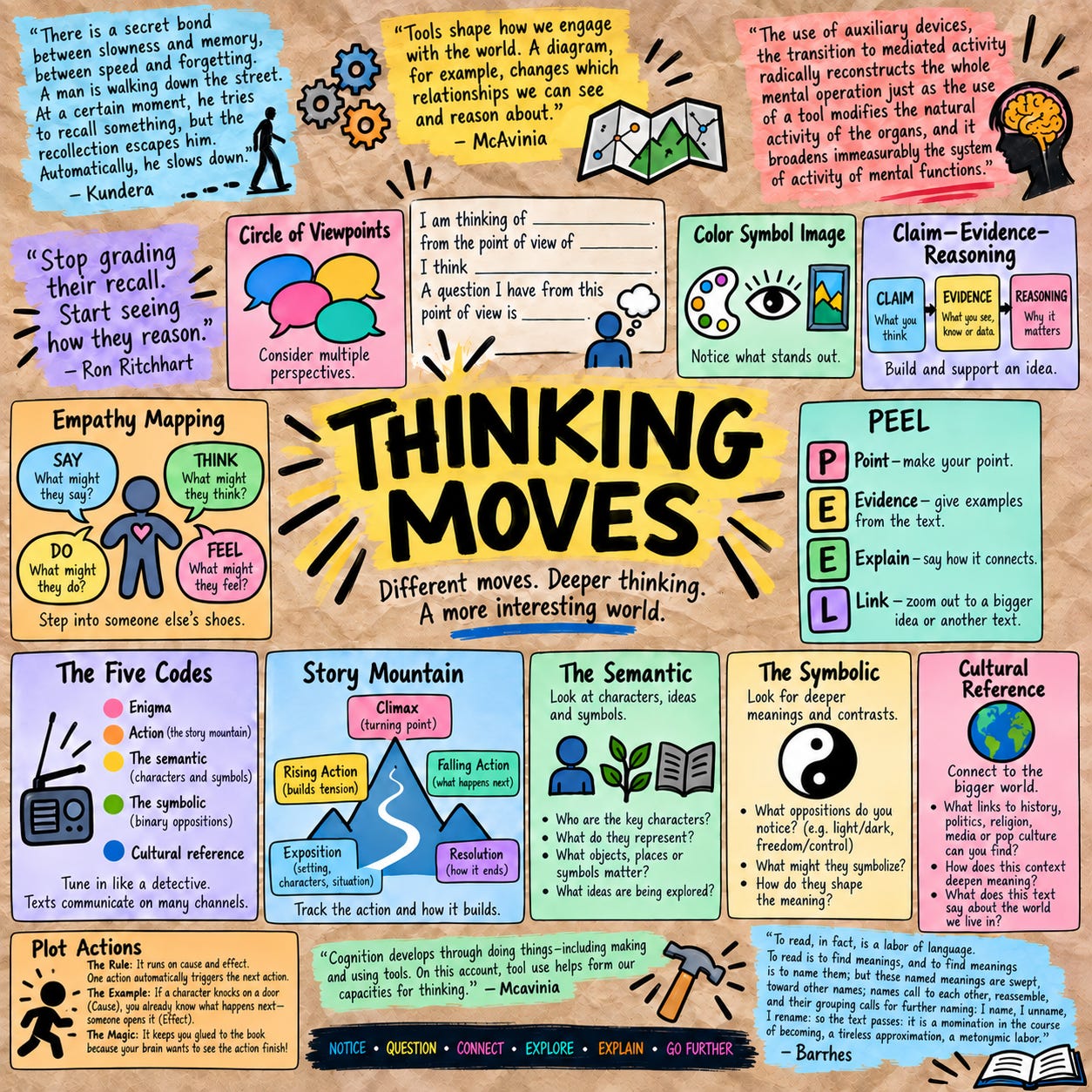
Middle schoolers take to this faster than adults expect. Thinking is messy, at their age sometimes unbridled. Vygotsky wrote about tools and how they extend our thinking. I might suggest a reverse engineering of this, thinking of tool more as harvester or conduit affording a goal or focus, mediating a student’s raw cognitive energy. Once told there are five channels running through a story that when connected create something akin to melodies and chords, and that they can choose which to listen to, or that there are secret thoughts and feelings of characters that authors purposefully leave untold, they apply the tool and pursue.
The toolkit grew all year during the read-aloud and guided reading, and over two years students had a menu of choices. They were never required to use these tools, although they often did. But when a student forms a whole argument around why she wishes the character in a story were real, listing the values behind the character’s actions, clearly aware of her own emotional responses as a reader, that serves as a reminder that tools are there to unlock the thinking, but if the thinking is already happening, let if flow.
Support 6: Questions They Write Themselves
Teaching a student to ask a Socratic question is slow work. Through read-aloud and guided reading they are steadily confronted with provocations, usually built off one of Barthes’ five codes or off a Common Core standard. In the silent reading interviews you find out whether any of it transferred, evident in their own questions.
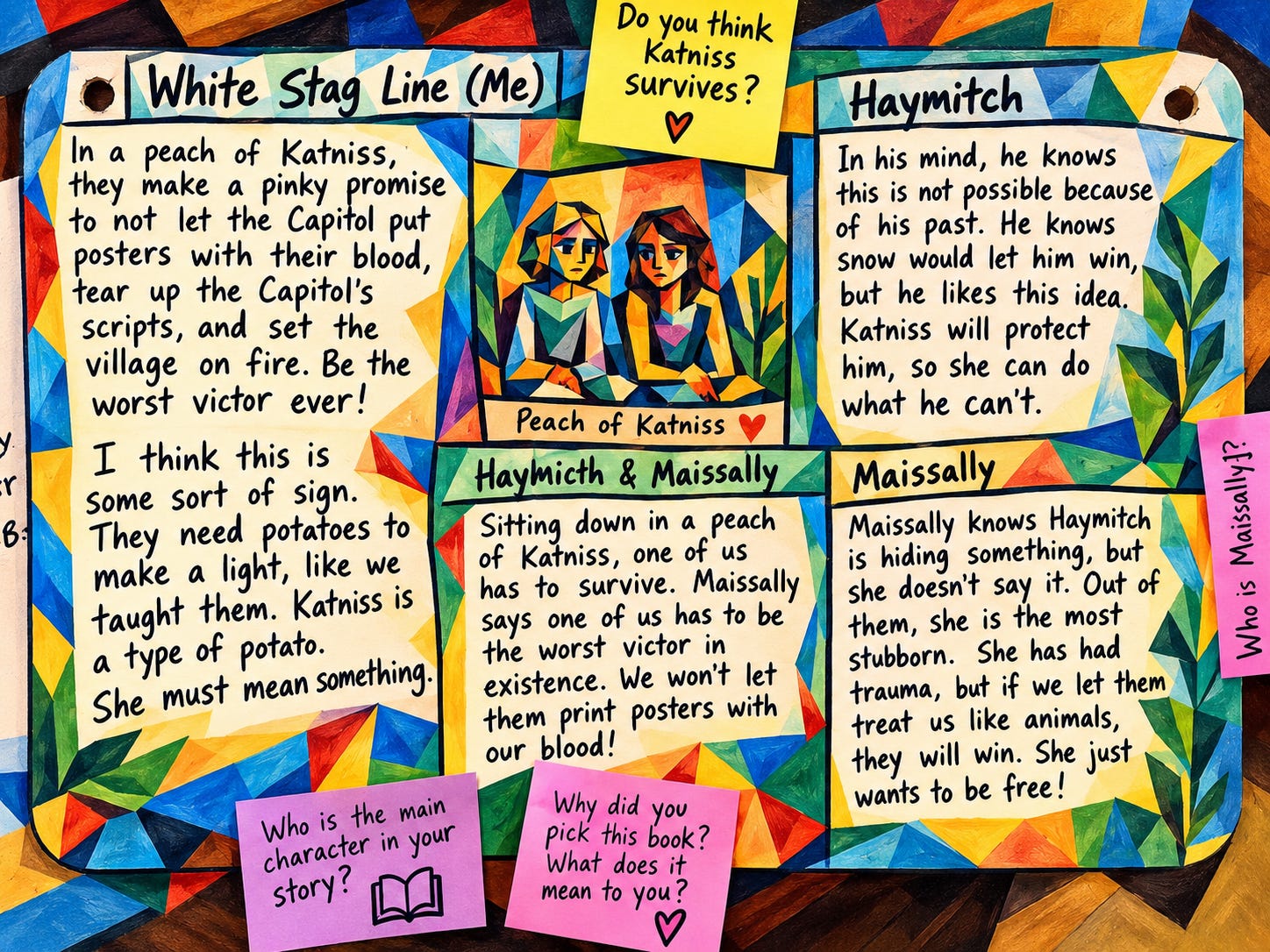
Students write four or five questions for a partner, and they begin the way good interviewers do, by quoting something the partner has already written and building the question out of it. Then they confer with a teacher.
This pre-interview, done with most of the class present, was often half the fun. Students would start weighing the questions they were about to be asked and lobbying for revisions to them. Kath Murdoch would call this leading with an inquiry stance, amplifying learner agency.
The interview
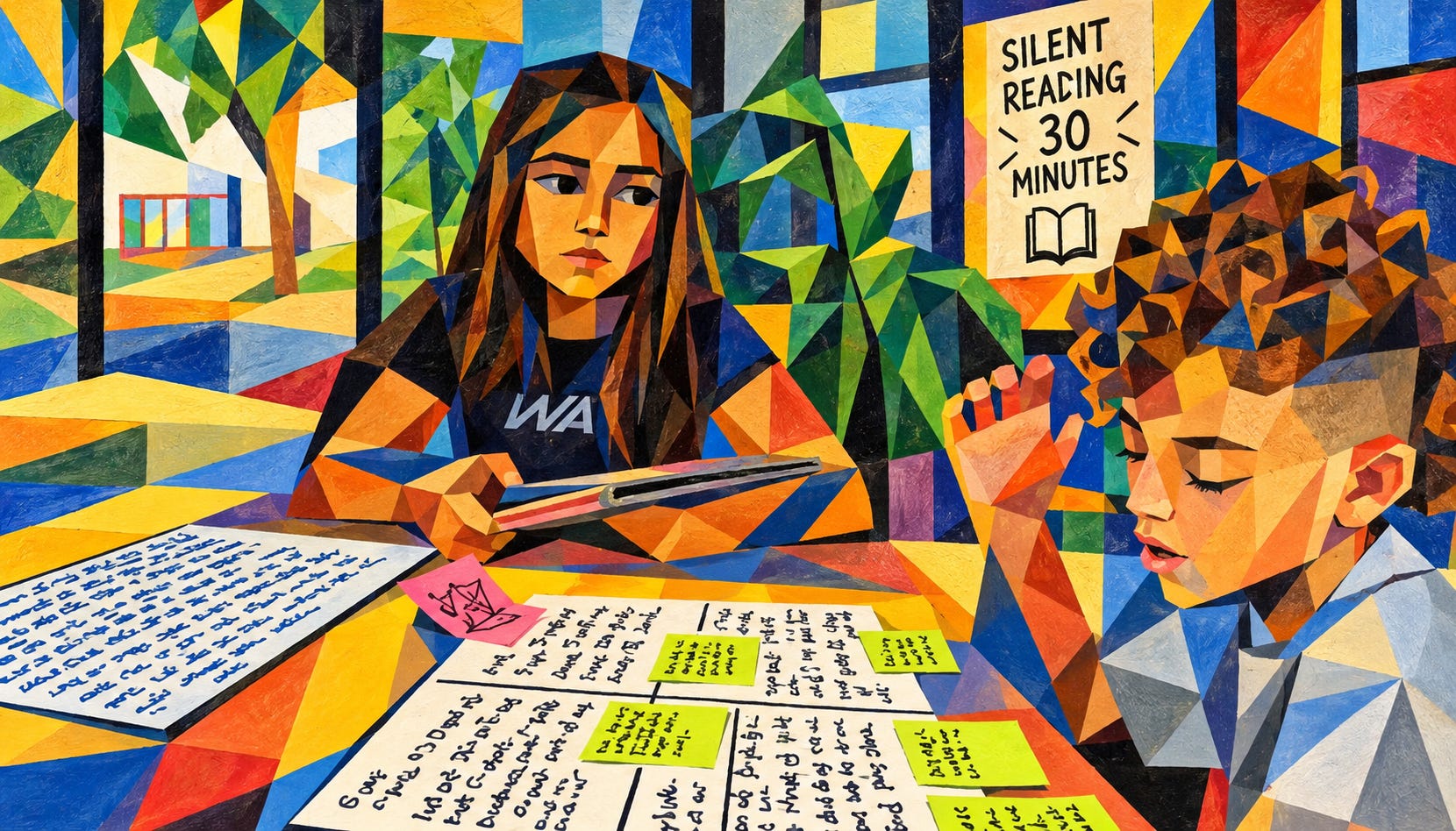
When the questions are ready, the pair separates from the class and records.
Everything up to this point has been closely watched, in the presence of adults. Here I encouraged independence, and accepted that some drift was part of the price. After all that preparation, it was rare that an interview went badly. Adults stayed within reach, ready to join one if it needed rescuing.
The transcript
Interviews were transcribed into a single shared Google Doc. The AI tools improved across the two years, apps like Voice Notes arrived with transcription built in, and we ran Whisper on the main teacher computer.
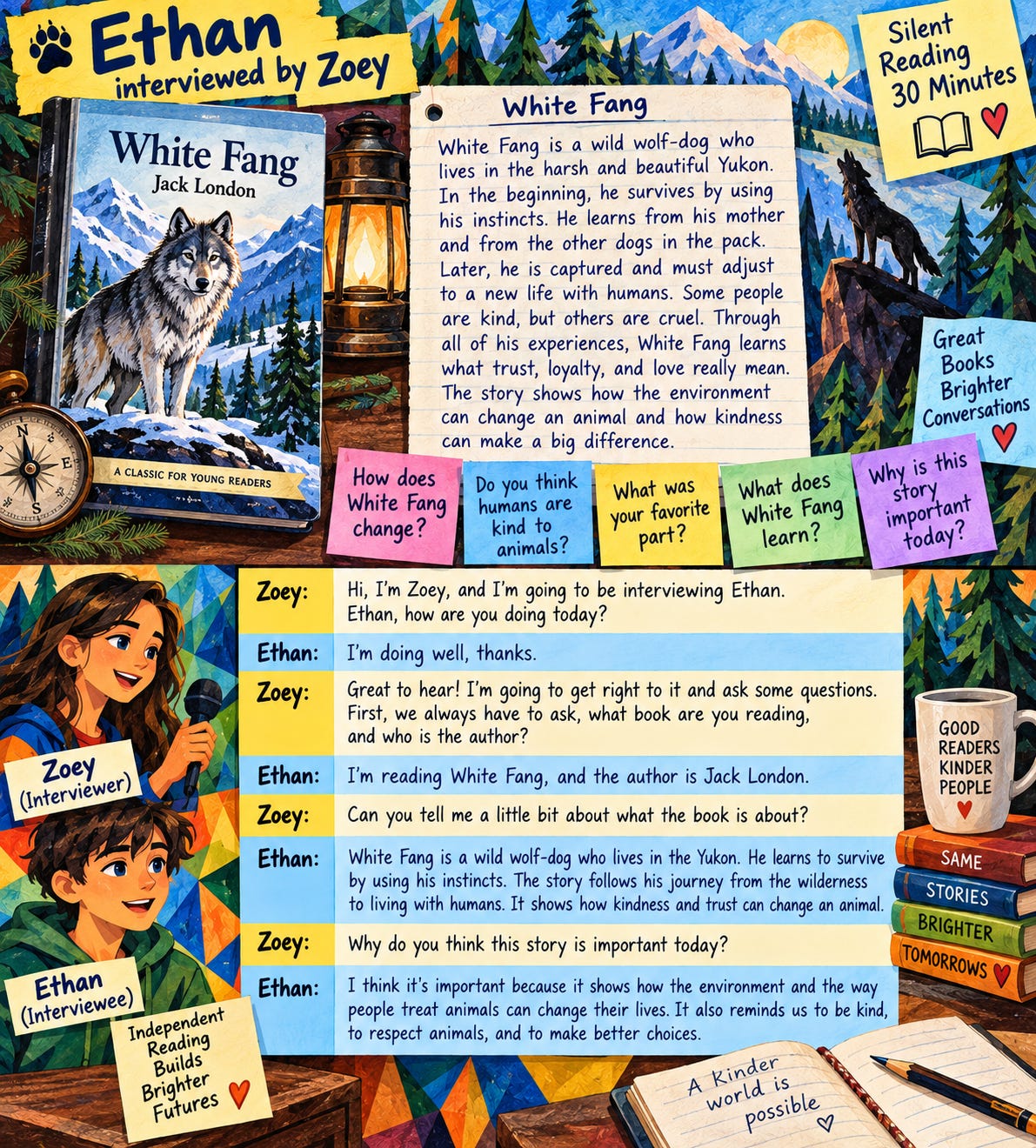
Students then formatted, fixed wording, and extended parts of their own interview. This was another checkpoint: if an interview hadn’t pulled much out of a student, we could simply keep interviewing in real time and transcribe straight into the document. We photographed the boards and the questions alongside the book and dropped the image into the doc.
We were one step from a weekly podcast. Time never quite allowed it as we were always rushing to package the document before the bell.
Support 7: Invisible Assessments
The students never saw an assessment from any of this.
What the work produced instead was a very large archive. AI transcription has quietly changed what kind of thinking is accessible to a teacher, not the written product, which we always had, but the talk, which we mostly lost. After a few weeks we had a bank of real student reasoning deep enough to pull mini-lessons straight out of. Across the various individual interventions running in parallel, that record could fill in a picture of a standard or a report-card indicator a student hadn’t demonstrated anywhere else.
There is obvious tension. I began by complaining about screens sitting between children and their attention, and I am now recommending a machine that scrapes their conversations. So let me be exact about the division of labor.
The machine transcribes so that the adult can listen. It does not do the listening.
Screens and AI have become metaphors for passive consumption and cognitive deskilling. I would argue that it is not the screens themselves but atrophy through cognitive offloading that becomes the default. We do not have to accept that, just as we do not have to accept the OECD PISA reports as predictive of our next steps. Our schools, our model democracies, are exactly where screens and AI deserve careful focus. University of Chicago’s ai zoning policies and NYC school districts’ AI pause are the right ideas. Yet neither approach amounts to rejecting AI. Both attempt to define where the technology can extend human agency without displacing it.
And the surprise, when I went back through that archive, was not where I expected it.
It was not in students analyzing a character’s point of view (CCSS.ELA-LITERACY.RL.7.6), which they did. It was not even in the standard I care most about, building on others’ ideas and modifying their own (CCSS.ELA-LITERACY.SL.7.1), which they also did.
It was in the Habits of Mind that accumulated over two years. It was hearing a student step outside his own ego, mid-interview, and perceive the perspective and the feelings of the person across the table.
We talk a lot about making learning visible. A long ethnographic record like this one with sketches, reflections, recorded talk, curated with some AI help, offers a genuinely different view of how students think through literature when they have a toolkit and consistent routines.
A text begins privately, inside one reader’s experience, but becomes knowledge through what happens between text, reader and other people.
I have said before, on the blog and on the podcast, that our word for assessment comes from the Latin assidere: to sit beside. An assessor was the person who sat next to the judge. Sitting beside and discussing is not a soft alternative to assessment, it is the original meaning of the word. That is the core of a reading intervention and may also be the answer to why we read at all, to create this enaction. A text begins privately, inside one reader’s experience, but becomes knowledge through what happens between text, reader and other people.
Coda: What the Logs Said
The changes were hard to miss.
One student read more than twenty books in a year. Another moved from graphic novels to choosing prose for the first time. A third arrived late to the cohort with no English at all and finished reading adapted classics.
Book choices got harder. Stamina grew. Students who logged more sustained reading time tended to show stronger growth on i-Ready. With ten students, and five parts of the intervention running at once, I would not claim silent reading caused any of it. But as a believer in radical empiricism, close observation of the web of relations leads me to a Dewey live hypothesis. Communities of student readers and interviewers are creating schemas and a culture that transfers far beyond the bump in test scores. That data is important institutionally, but the better approach to what happened here is by looking at what developed in their Habits of Mind.
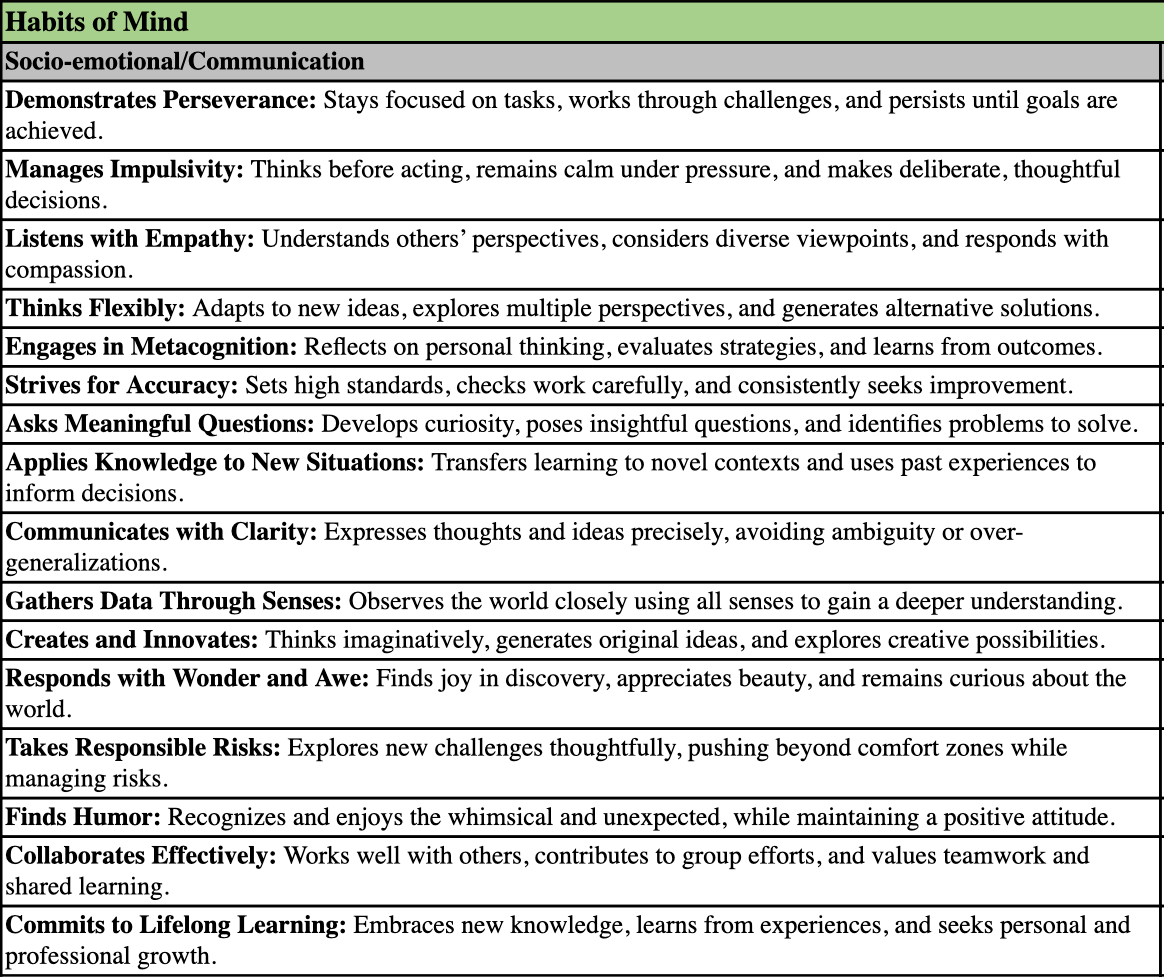
In this literacy block, the teacher becomes an ethnographer noticing the quality of the questions, the care in choosing a thinking tool, the close listening in an interview and the follow-up that proves it, the drift into new genres, the meticulous editing of a final document.
There are no summative takeaways here. Literacy development has too many variables to hold still. You can run Hattie-scale meta-analyses trying to isolate a cause, or you can sharpen your own senses and watch closely what each part of your literacy program actually does. The second costs very little. Post-its, Sharpies, wipe boards, a Google account, a small library. You can spend two hundred thousand balboas on curricular reform, or you can make a plan and start Monday morning.
Back at the café the rain died down and the clouds lifted out of the forest. The screens did not. I paid up, and walking out I remembered something a veteran teacher, my mom, told me in my first year, “There is no such thing as a child who doesn’t like to read and be read to. Some of them just don’t know it yet.”

No comments:
Post a Comment